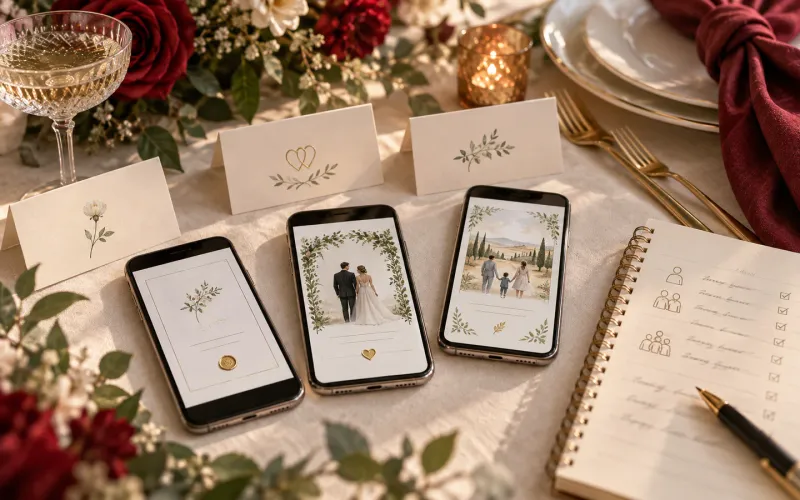
Digital wedding invitation checklist: what to include
From the date and venue to RSVP questions and guest-specific details, use this practical checklist to make sure your digital wedding invitation includes what guests actually need.
 BedrosCo-founder
Last Updated: 20 Sep, 2026 • 5 min read
A wedding invitation has two jobs. It should make the day feel real, and it should help every guest understand what happens next.
The first part is emotional: the names, photographs, colours and small details that make the invitation feel like yours. The second is practical: where to go, when to arrive, what to wear and how to reply. The best digital invitations do both without making guests hunt for information.
This checklist covers the details worth gathering before your invitation is personalized, plus a few things that are usually better left out.
The essential wedding details
Start with the information every invited guest needs, regardless of how formal or relaxed the celebration will be.
- Your names. Use the version of your names you want guests to see. That may be full names, first names or a familiar shortened form.
- The wedding date. Include the day of the week as well as the full date. It gives guests one more way to notice a calendar mistake.
- The main location. Give the venue name, town or city, and a map link. If the ceremony and reception are in different places, list both clearly.
- The start time. Say whether the time shown is the ceremony time or the time guests should arrive.
- A clear RSVP action. Guests should immediately understand where to respond and when their reply is due.
Read these details once as though you know nothing about the wedding. If you would need to send a follow-up message, the invitation probably needs one more line.
A schedule guests can scan
Not every invitation needs a minute-by-minute itinerary. Most do benefit from a short order of events, especially when guests move between locations.
A useful schedule might include:
- Guest arrival
- Ceremony
- Drinks or photographs
- Dinner
- Dancing or after-party
Keep it at the level guests need for planning. The exact moment the speeches begin matters to your coordinator; it rarely matters to someone deciding which train to catch.
For a wedding weekend, separate events by day and make it obvious which ones are open to all guests. A welcome dinner, ceremony and farewell brunch can sit comfortably in one invitation when each has its own heading, time and location.
RSVP questions that earn their place
Every extra question creates a little more work for the guest and a little more information for you to manage. Ask only what will change a decision.
Useful RSVP questions include:
- attending or not attending;
- which invited guests will attend;
- meal choice, when the venue requires it;
- dietary requirements or allergies;
- attendance at additional wedding events; and
- transport needs, when you are arranging a shuttle.
Avoid collecting information simply because the form allows it. If you will not use a guest’s phone number, social handle or mailing address, do not ask for it.
Details for travel and destination weddings
Guests travelling to the wedding need a little more help. Give them enough information to make plans without turning the invitation into a travel guide.
Consider including:
- the nearest airport or station;
- recommended accommodation or a booking code;
- transport between the hotel and venue;
- the expected weather or terrain;
- passport or entry reminders for international guests; and
- a local contact for urgent questions during the wedding weekend.
Link to longer information where possible. A concise invitation with a useful map is easier to navigate than a beautiful page interrupted by six paragraphs of directions.
Dress code, gifts and other expectations
Dress codes are most helpful when they are specific enough to guide people. “Formal” can mean different things in different places; a short explanation such as “suits and floor-length or cocktail dresses” removes uncertainty.
If the venue has practical requirements, say so. Grass, gravel, religious customs, strong afternoon sun and cool evenings can all affect what guests choose to wear.
Gift information should be easy to find but does not need to lead the invitation. A registry link, honeymoon-fund note or a simple request for no gifts can sit near the end, after the event details and RSVP.
Make the invitation fit the guest
One shared wedding does not mean every guest needs identical information. A personalized invitation can reflect whether it is being sent to one person, a couple or a family, and whether a plus-one is included.
Guest-specific invitations help answer common questions before they are asked:
- Who exactly is invited?
- Are children included?
- May I bring a guest?
- How many people can I confirm?
If your guests speak different languages, the same applies to the words themselves: an invitation offered in two languages, with a simple switch between them, lets each guest read it in the one that feels most natural.
This is one reason we include personalized invitations for each guest rather than asking couples to send one generic link to everyone.
What to leave out
An invitation does not need to contain every decision you have made. Leave out information that is not final, not useful to guests or better handled privately.
That usually means:
- an unfinished schedule;
- internal planning notes;
- supplier contact details;
- long explanations for wedding decisions;
- private family arrangements; and
- policies written in a way that makes guests feel scolded before they arrive.
Clear boundaries are fine. Warm, direct wording usually works better than a list of warnings.
The final check before sharing
Before the invitation goes out, test it on a phone and ask someone outside the planning process to read it. They should be able to answer five questions without asking you for help:
- Who is getting married?
- When and where is the wedding?
- Who is included in this invitation?
- What do I need to do now?
- Where can I find the details again later?
Check every link, submit a test RSVP and read the confirmation. Then look at the invitation one last time for tone: it should feel less like a form and more like the beginning of the celebration.
If you are ready to start with the visual side, you can browse our digital wedding invitation designs. Once you choose one, the checklist above helps you prepare the content for your invitation.